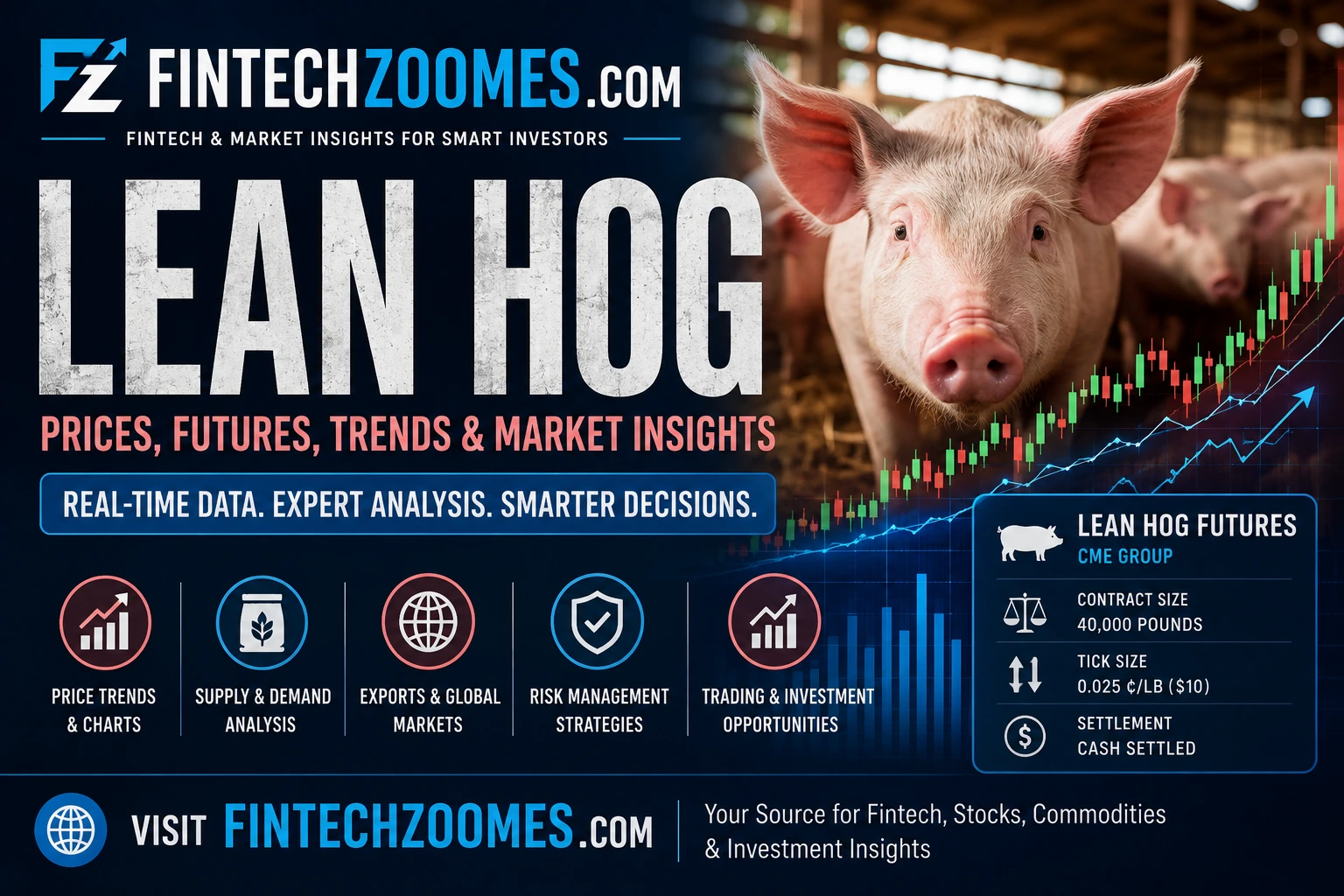
FintechZoom.com Lean Hog: Complete Guide to Prices, Futures, Trading, and Market Trends
The FintechZoom.com Lean Hog market is an important part of the global agricultural commodities sector. Lean hog futures connect the financial market with the real-world pork industry, giving producers, processors, investors, and traders a way to manage exposure to changing livestock prices.
Unlike traditional stocks, livestock markets are influenced by biological production cycles, feed expenses, consumer purchasing patterns, disease risks, exports, weather, and seasonal demand. A change in any one of these areas can affect expectations for future hog supplies and ultimately influence prices.
Understanding this market requires more than watching a futures chart. Investors and traders need to understand how hogs move through the supply chain, what determines pork demand, how feed costs affect producers, and why futures prices can change before physical market conditions become obvious.
This guide explores the fundamentals of lean hog futures, the forces behind price movements, trading strategies, investment considerations, risks, and practical ways to analyze the market.
What Are Lean Hog Futures?
Lean hog futures are standardized financial contracts based on the value of hogs used in pork production. They are primarily designed to help businesses manage price uncertainty, but they are also actively followed by traders and commodity investors.
The market provides a way for participants to establish financial positions based on their expectations about future livestock prices.
For a pork producer, the concern may be falling hog prices between the time animals are raised and the time they are sold. A processor may face the opposite problem and worry about increasing costs. Futures can help these businesses manage part of that uncertainty.
Speculators approach the market differently. Instead of using futures to protect an existing agricultural business, they attempt to profit from price changes.
This creates a market where commercial hedgers and financial traders interact.
Why Are Lean Hog Futures Important?
Livestock production involves uncertainty that cannot easily be eliminated.
A producer does not know exactly what market prices will be several months ahead. Feed costs can change. Consumer demand can weaken. Disease can affect herds. Export markets can suddenly become less attractive.
Futures provide a standardized marketplace where participants can transfer some of that price risk. That makes the market useful not only for traders but also for the wider pork industry.
How the Pork Market Works
To understand livestock prices, it helps to follow the journey from breeding to the consumer.
The process starts with breeding and raising hogs. Producers invest in feed, housing, labor, veterinary care, genetics, energy, and transportation.
Young animals eventually enter the finishing stage, where they are raised to market weight.
After that, hogs are sold to processors. The animals are slaughtered and converted into pork products that enter grocery stores, restaurants, food-service businesses, and international markets.
The basic process is:
Breeding → Raising → Feeding → Finishing → Processing → Distribution → Consumers
Every stage has an economic impact.
For example, higher feed prices can increase production expenses. Weak consumer demand can reduce the amount processors are willing to pay. Strong exports can increase demand for pork and improve market conditions.
This interconnected structure explains why livestock futures can react to information from several different industries.
What Drives Lean Hog Prices?
Several factors influence livestock prices at the same time. The most important ones are supply, demand, production costs, exports, disease, and seasonality.
Hog Supply
The number of hogs available for slaughter is one of the central factors affecting prices.
If the market expects a significant increase in available animals, buyers may have more negotiating power. If supplies become tighter, competition among buyers can increase.
Supply expectations can influence futures prices months before the actual change reaches the physical market.
This is why traders pay attention to herd numbers, breeding activity, slaughter rates, and production forecasts.
Consumer Demand
Pork consumption is another major component.
Household budgets, restaurant activity, food prices, holidays, dietary preferences, and competition from beef and poultry can all affect demand.
When consumers purchase more pork, processors may require greater supplies. When consumption declines, the market can face downward pressure.
Consumer demand is especially important because strong production does not automatically lead to strong prices. The market needs enough demand to absorb available supplies.
Export Markets
International trade plays a major role in the pork industry.
Countries that import pork can represent significant sources of demand for producers and processors. However, export volumes can change because of tariffs, currency movements, economic conditions, trade agreements, shipping costs, and political developments.
A stronger domestic currency can make exports more expensive for foreign buyers, while favorable exchange rates can improve competitiveness.
Therefore, traders should pay attention to both domestic consumption and international demand.
The Connection Between Feed Costs and Hog Prices
One of the most interesting relationships in livestock markets is the connection between hog prices and feed costs.
Raising hogs requires substantial quantities of feed. Corn and soybean products are particularly important ingredients in many livestock rations.
When feed prices increase sharply, production expenses can rise. If hog prices fail to keep pace, producer margins may become tighter.
Lower feed prices can have the opposite effect by improving production economics.
This relationship means livestock traders often watch agricultural grain markets alongside hog futures.
However, the relationship is not perfectly predictable.
A rise in feed costs does not automatically mean hog prices will rise. Producers may adjust production decisions, feed efficiency can change, and consumer demand may move independently.
The broader lesson is that livestock markets should be analyzed as part of a larger agricultural ecosystem.
Why Disease Can Change the Market Quickly
Animal health is one of the biggest risks in livestock production.
Disease outbreaks can affect herd sizes, slaughter schedules, production costs, transportation, and international trade.
The market reaction can sometimes be particularly sharp because traders are responding not only to current conditions but also to uncertainty about future supplies.
Disease concerns can also influence international trade. Some countries may restrict imports from affected regions, while producers and governments may introduce measures designed to limit the spread.
For traders, disease developments can therefore become important market-moving events.
Seasonal Patterns in Livestock Markets
Livestock markets often display seasonal tendencies because animal production and consumer demand follow recurring patterns.
Pork demand may change around holidays and other periods when consumer purchasing behavior increases. Production and slaughter volumes can also fluctuate during the year.
Seasonality can help traders establish context, but it should never be treated as a guaranteed price signal.
A historical tendency becomes more useful when it agrees with current fundamentals.
For example, if seasonal demand typically strengthens during a particular period and current supply conditions are also tightening, traders may view the combination differently than they would if inventories were already abundant.
The strongest analysis combines seasonality with current information rather than relying on historical patterns alone.
FintechZoom.com Lean Hog Futures vs. Other Investments
Investors interested in agricultural markets have several ways to gain exposure.
Futures Contracts
Futures offer relatively direct exposure to livestock price movements.
They are commonly used for hedging and speculation, but leverage makes them unsuitable for careless trading. A relatively small percentage movement in the underlying market can produce a much larger percentage change in the amount of capital committed as margin.
Options
Options provide another method for managing or gaining exposure to futures markets.
Depending on the strategy, options can be used to limit certain risks while maintaining potential exposure to favorable price movements.
However, options have their own complexities, including premiums, expiration dates, strike prices, volatility, and time decay.
Agricultural Stocks
Another approach is investing in publicly traded companies involved in meat processing, food production, agriculture, animal health, equipment, feed, or logistics.
These businesses can benefit from favorable agricultural conditions, but their stock prices are affected by many factors beyond livestock prices.
Commodity Funds
Commodity-focused funds may provide a simpler route for investors who do not want to trade individual futures contracts.
However, investors should understand exactly what a fund holds and how it obtains commodity exposure. Performance can differ from the physical market because of futures contract structure and other investment mechanics.
FintechZoom.com Lean Hog Market Analysis
A useful market analysis combines fundamental information with price behavior.
Fundamental Analysis
Fundamental analysis examines the physical supply-and-demand picture.
Important factors include:
- Hog inventories
- Slaughter numbers
- Pork production
- Consumer demand
- Export activity
- Feed costs
- Herd expansion or contraction
- Disease developments
- Seasonal demand
- Pork market values
The objective is to determine whether available supplies appear adequate relative to expected demand.
Technical Analysis
Technical traders focus primarily on price and market structure.
They may use:
- Moving averages
- Support and resistance
- Trendlines
- Volume
- Momentum indicators
- Breakout patterns
- Historical price ranges
Technical analysis can help identify potential trading setups, but it does not explain the underlying cause of a market move.
For this reason, combining technical information with fundamental research can provide a more complete picture.
Futures Curve Analysis
Experienced traders may also compare different futures contract months.
The relationship between nearby and later contracts can provide information about market expectations.
When contract prices behave differently across the futures curve, the structure may offer clues about anticipated supply, demand, and seasonal conditions.
This is a more advanced technique, but it can be useful for traders who want to understand the market beyond a single price chart.
Reports and Data Traders Should Monitor
Agricultural and livestock markets are heavily influenced by new information.
Market participants often monitor data related to:
- Livestock inventories
- Hog slaughter
- Pork production
- Export sales
- Consumer demand
- Feed prices
- Producer margins
- Breeding activity
- Market weights
- Disease developments
The timing of reports can also increase volatility.
A report that contains unexpected information may trigger a sharp price move because traders immediately adjust their expectations.
The important point is that the market reacts to surprises.
If traders already expect supplies to increase substantially, a large supply number may have little impact. But if the actual figure is dramatically different from expectations, the reaction can be much stronger.
How to Build a Lean Hog Trading Strategy
There is no single strategy that works under every market condition.
A disciplined trader can begin with a simple framework.
1. Identify the Current Trend
Determine whether prices are generally moving higher, lower, or sideways.
2. Examine Supply
Look for evidence of increasing or decreasing hog availability.
3. Study Demand
Monitor domestic pork consumption and export activity.
4. Check Feed Costs
Compare current feed prices with historical levels and producer economics.
5. Review Seasonal Factors
Determine whether current market conditions fit typical seasonal behavior.
6. Watch Major Reports
Know when important agricultural and livestock data will be released.
7. Establish Risk Limits
Decide in advance how much capital can be placed at risk.
8. Avoid Emotional Trading
Do not increase a position simply because a trade is moving against you.
A trading plan should be designed before the market becomes volatile, not during a panic.
Major Risks of Lean Hog Investing
Livestock markets can provide opportunities, but they also carry significant risks.
Market Volatility
Prices can change quickly when new supply, demand, weather, disease, or trade information enters the market.
Leverage
Futures allow traders to control a relatively large position using margin. This increases both potential gains and potential losses.
Unexpected Disease Events
Animal health problems can dramatically change production and trade expectations.
Changing Consumer Preferences
Food preferences can evolve over time. Changes in consumer demand can affect pork consumption and industry economics.
Feed Price Shocks
Large movements in grain markets can affect production costs and producer profitability.
Trade Restrictions
Tariffs, import restrictions, export policies, and geopolitical events can change international demand.
Economic Conditions
Inflation, unemployment, interest rates, and household purchasing power can influence food consumption and restaurant activity.
Understanding these risks is just as important as identifying potential opportunities.
How Beginners Can Research the Market
A new investor does not need to understand every agricultural indicator immediately.
Start with the fundamentals.
First, learn how hogs are produced and processed. Then understand how supply and demand influence prices.
Next, become familiar with the relationship between livestock and feed grains.
After that, study futures contracts and learn how margin works before considering leveraged trading.
A beginner-friendly research routine might look like this:
Monday: Review market prices and major agricultural news.
Tuesday: Examine supply and demand developments.
Wednesday: Check feed costs and export conditions.
Thursday: Review technical price patterns.
Friday: Evaluate the week’s major developments and update the market outlook.
The objective is not to predict every daily move. It is to build a consistent understanding of the market.
FintechZoom.com Lean Hog and Long-Term Market Outlook
The long-term outlook for livestock markets will depend on population growth, global protein consumption, production efficiency, feed economics, technology, disease management, and international trade.
Modern farming technology continues to improve breeding, nutrition, animal health, and production efficiency.
Better genetics and feed management can allow producers to raise animals more efficiently, potentially lowering the resources required per unit of output.
At the same time, environmental concerns and changing consumer expectations may influence how pork is produced and marketed.
International demand will remain another important variable. Countries with growing populations and expanding middle classes may increase demand for animal protein, although consumption patterns will vary by region.
Climate and resource availability could also affect production costs over the long term.
These trends make livestock markets worth watching even for investors who do not actively trade futures.
Expert Tips for Managing Risk
Good risk management can make a greater difference than finding a perfect market prediction.
Consider these principles:
- Never assume prices must continue moving in the same direction.
- Understand contract size before entering a futures position.
- Keep leverage under control.
- Follow fundamental data as well as charts.
- Track feed costs when evaluating producer economics.
- Watch international trade developments.
- Avoid oversized positions around major reports.
- Consider diversification rather than concentrating on one commodity.
- Keep emergency and essential funds separate from speculative capital.
- Review your investment thesis whenever major market conditions change.
A trader’s goal should not be to eliminate uncertainty. That is impossible. The goal is to make uncertainty manageable.
FAQs
What is FintechZoom.com Lean Hog?
FintechZoom.com Lean Hog refers to the market and investment topic surrounding lean hog futures, pork production, livestock prices, trading activity, and factors influencing the U.S. hog industry. It covers both the physical agricultural market and the financial instruments used by producers, commercial businesses, and traders to manage or speculate on price movements.
What causes lean hog prices to move?
Lean hog prices can change because of shifts in hog supplies, pork demand, feed costs, exports, disease conditions, slaughter rates, seasonal patterns, and broader economic developments. Market expectations are also extremely important. Prices can move sharply when newly released information differs from what traders previously anticipated.
Are lean hog futures risky?
Yes. Futures can be volatile and involve leverage, which means relatively small movements in the underlying market can produce significant gains or losses. Traders also face risks from unexpected changes in supply, demand, disease, feed costs, and international trade. Anyone considering futures should understand margin requirements and establish appropriate risk limits before trading.
How does corn affect the hog market?
Corn is an important feed ingredient for livestock, so changes in its price can affect the cost of raising hogs. Higher feed costs may reduce producer margins, while lower feed prices can improve production economics. The relationship is not automatic because hog prices, feed efficiency, production decisions, and consumer demand also influence profitability.
Can beginners invest in lean hog futures?
Beginners can study and learn the market, but futures trading requires a strong understanding of leverage, margin, contract specifications, and risk management. New participants should avoid treating futures like ordinary shares. Building knowledge through market observation and simulated trading can be useful before committing capital to a leveraged position.
Why are exports important to pork prices?
Exports provide an additional source of demand for pork producers. When international buyers increase purchases, domestic supplies may become tighter, potentially supporting prices. When exports weaken because of economic conditions, tariffs, currency movements, or trade restrictions, additional pork may remain in the domestic market, potentially changing price dynamics.
How can traders analyze the lean hog market?
Traders can combine fundamental and technical analysis. Fundamental research examines hog supplies, slaughter numbers, pork production, exports, feed costs, consumer demand, and disease developments. Technical analysis examines trends, support and resistance, momentum, volume, and price patterns. Using both approaches can provide a more balanced view than relying on either method alone.
Is seasonality useful when trading livestock?
Seasonality can provide useful context because pork demand and livestock production follow recurring annual patterns. However, historical tendencies should not be treated as guaranteed outcomes. Current supply levels, demand conditions, feed costs, exports, and unexpected events can override normal seasonal behavior. Seasonality works best as one part of a broader market-analysis process.
Final Thoughts
The livestock market brings together agriculture, finance, consumer behavior, global trade, and commodity economics. Its price movements can be complicated because several forces often change simultaneously.
For anyone researching FintechZoom.com Lean Hog, understanding the fundamentals is more valuable than simply searching for a short-term price prediction. Supply, demand, feed costs, exports, disease, seasonality, and market expectations all deserve attention.
Lean hog futures can serve commercial hedging purposes and offer opportunities for experienced traders, but leverage and volatility require careful risk management. A thoughtful approach starts with understanding the underlying pork industry, choosing an appropriate investment method, and maintaining realistic expectations.
The best market decisions come from preparation, disciplined research, and an ability to manage risk when conditions do not develop as expected.
Posts on FintechZoomes.com:
FintechZoom.com Brent Crude: Understanding Prices, Benchmarks and Market Drivers
FintechZoom.com Crude Oil: Understanding Brent Prices, Market Drivers, and Oil Benchmarks
FintechZoom.com Platinum: Price Trends, Uses, Investment Insights and Market Outlook