FintechZoom.com Bonds: A Complete Guide to Understanding Bond Markets
When people talk about financial markets, stocks and cryptocurrencies usually receive most of the attention. However, the bond market plays an equally important role in the global economy. It influences interest rates, borrowing costs, investment decisions, and even the direction of other financial markets.
FintechZoom.com Bonds provides readers with a useful way to explore this often-complicated part of finance. Instead of focusing only on numbers, bond-related coverage can help investors understand Treasury yields, interest-rate movements, corporate debt, and the relationship between bonds and other asset classes.
Whether you are an experienced investor or someone who is simply trying to understand why interest rates keep appearing in the financial news, learning how the bond market works can give you a much clearer view of the economy.
What Is FintechZoom.com Bonds?
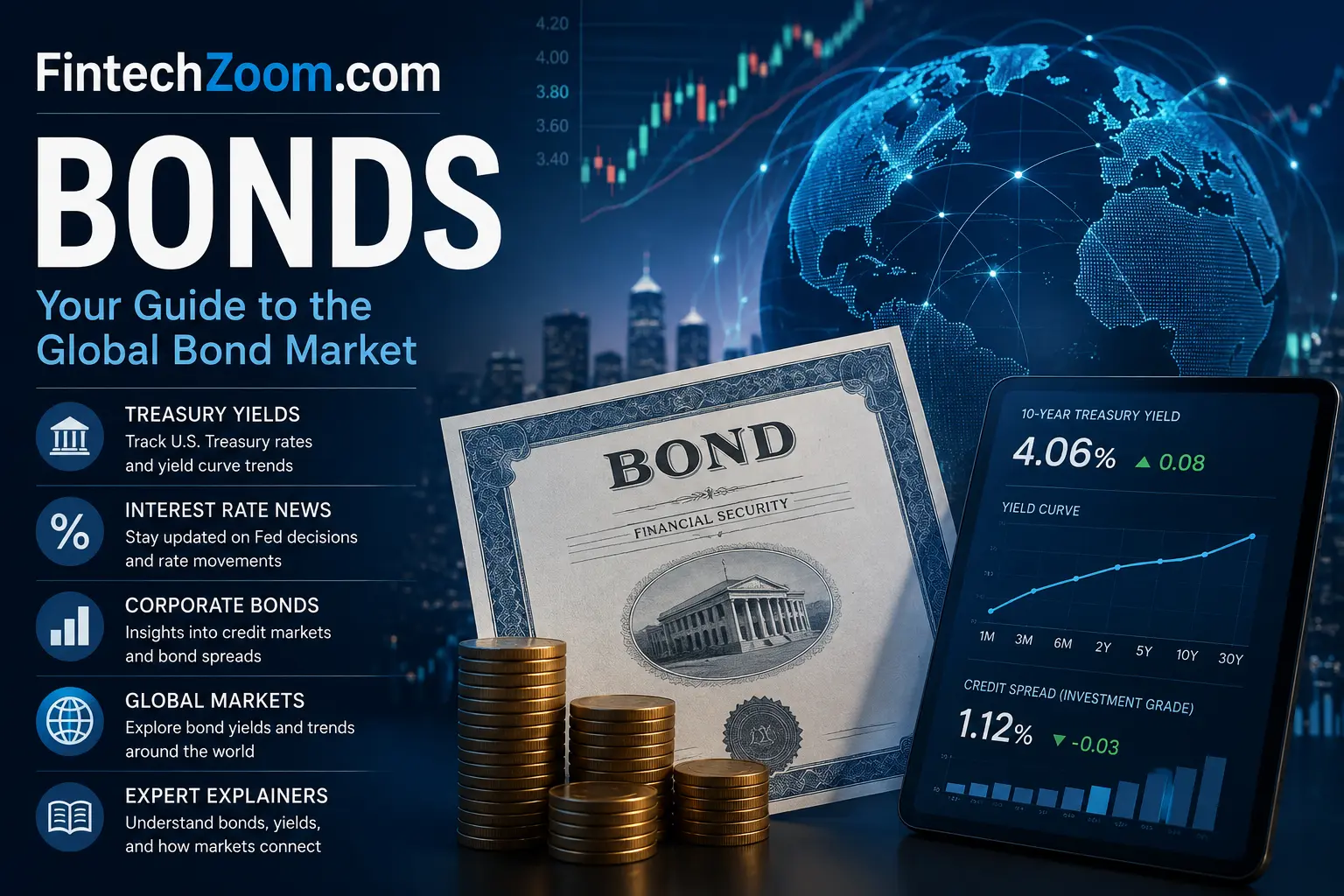
FintechZoom.com Bonds refers to bond-market coverage focused on fixed-income investments and the economic factors that influence them. Bonds are essentially debt instruments. Governments, companies, and other organizations issue them to borrow money from investors, promising to make interest payments and return the principal according to the terms of the security.
Bond coverage generally includes several important areas:
- U.S. Treasury yields and government debt
- Federal Reserve decisions and interest-rate expectations
- Corporate and high-yield bonds
- Credit-market conditions
- International bond markets
- Yield-curve movements
- Educational explanations for new investors
The biggest advantage of following this type of coverage is that it puts individual market movements into context. Instead of simply seeing that a Treasury yield has increased, readers can explore the economic developments that may have caused the change.
Why Bond Markets Matter
You do not have to own a single bond for the bond market to affect your financial life.
Government bond yields influence the pricing of many other financial assets. When Treasury yields change, investors reassess the attractiveness of stocks, corporate debt, real estate, and other investments.
Bond markets are also closely connected to borrowing costs. Mortgage rates, business loans, and other forms of credit can be influenced by changes in interest rates and government bond yields.
This makes bond-market information useful for several types of people, including investors, homebuyers, business owners, and anyone interested in economic trends.
Understanding Treasury Yields
Treasury securities are among the most closely followed instruments in the fixed-income market. They are issued by the U.S. government and come in different maturities.
The 2-year Treasury yield is particularly useful for understanding expectations surrounding monetary policy and short-term interest rates. Meanwhile, the 10-year Treasury yield is widely watched because it affects long-term borrowing costs and is an important reference point for financial markets.
Another important concept is the yield curve. It compares interest rates across different bond maturities.
Normally, longer-term bonds offer higher yields than shorter-term securities because investors generally expect additional compensation for committing their money for a longer period. When short-term yields rise above long-term yields, the curve becomes inverted.
An inverted yield curve has historically attracted significant attention because it has appeared before a number of U.S. recessions. It is not a guarantee that a recession will occur, but it is an economic signal that investors frequently monitor.
Interest Rates and Bond Prices
One of the first concepts every bond investor should understand is the relationship between bond prices and yields.
They generally move in opposite directions.
If market interest rates increase, newly issued bonds may offer more attractive yields. Existing bonds with lower coupon rates can therefore become less valuable, causing their market prices to decline.
The opposite can happen when interest rates fall. Existing bonds paying relatively higher rates may become more attractive, which can push their prices upward.
This relationship explains why Federal Reserve announcements can produce rapid movements in the bond market. Investors continuously adjust their expectations based on inflation, employment data, economic growth, and central-bank policy.
Corporate Bonds and Credit Risk
Government bonds are only one part of the fixed-income world. Companies also issue bonds to finance operations, expansion, acquisitions, and other business activities.
Corporate bonds are usually divided into broad categories based on credit quality.
Investment-grade bonds are issued by companies considered to have relatively strong financial positions and lower default risk. Because they carry less perceived risk, their yields are generally lower than those of riskier corporate debt.
High-yield bonds, sometimes called junk bonds, are issued by companies with greater credit risk. Investors demand higher yields as compensation for accepting that additional risk.
One useful indicator for understanding credit conditions is the credit spread. This represents the difference between the yield on corporate debt and the yield on comparable government securities.
When credit spreads become significantly wider, it can indicate that investors are becoming more concerned about economic conditions or corporate defaults.
How Bonds Influence the Stock Market
Although bonds and stocks are different investments, their markets are closely connected.
Higher bond yields can create challenges for stocks because investors have a more attractive alternative to riskier assets. Rising yields can also increase the discount rate used to value future corporate earnings, which can put particular pressure on companies whose valuations depend heavily on profits expected many years in the future.
Technology and other growth-oriented companies can therefore be sensitive to major changes in long-term interest rates.
On the other hand, falling yields can sometimes support equity valuations by reducing borrowing costs and making fixed-income investments relatively less attractive.
However, the relationship is not always straightforward. Investors need to consider why yields are rising or falling. A decline in yields caused by expectations of weaker economic growth can have very different implications from a decline caused by falling inflation expectations.
Global Bond Markets
The bond market extends far beyond the United States.
European government bonds, Japanese government securities, and emerging-market debt can provide important information about international economic conditions.
Central-bank policies in different countries can influence local bond yields, currencies, capital flows, and investor sentiment. For globally diversified investors, monitoring international fixed-income markets can therefore provide valuable additional context.
Emerging-market bonds may offer higher yields, but they can also expose investors to greater economic, currency, political, and credit risks.
How to Follow FintechZoom.com Bonds More Effectively
Simply reading every bond headline is not necessarily the best way to understand the market. A better approach is to develop a simple routine.
1. Watch the 2-Year and 10-Year Yields
These maturities can provide a quick indication of changing expectations about interest rates and economic growth.
2. Follow Federal Reserve Decisions
Fed meetings can have a major impact on Treasury yields and expectations for future monetary policy. Pay attention not only to the rate decision but also to the language used by policymakers.
3. Monitor Inflation
Inflation is one of the most important forces affecting interest rates. Higher-than-expected inflation can increase expectations for tighter monetary policy, while weaker inflation may support expectations for lower rates.
4. Check the Yield Curve
Comparing short-term and long-term yields can help you understand whether investors are expecting stronger growth, slower growth, or changing interest-rate conditions.
5. Look at Credit Spreads
Corporate credit spreads can provide another perspective on investor confidence. Rapid widening may suggest increasing concerns about corporate financial health or economic conditions.
Who Can Benefit From Bond-Market Coverage?
FintechZoom.com Bonds can be useful for more than professional investors.
New investors can use bond-market explanations to understand concepts such as yields, duration, interest rates, and credit risk.
Stock investors can monitor Treasury yields to understand why equity valuations may be changing.
Homebuyers can follow long-term interest-rate trends for additional context around mortgage-rate movements, although mortgage rates do not move in perfect lockstep with Treasury yields.
Business owners can gain insight into the broader cost of borrowing and corporate financing conditions.
Even people who never intend to purchase bonds directly can benefit because fixed-income markets are deeply connected to the wider economy.
Common Bond-Market Mistakes
A frequent beginner mistake is assuming that a higher bond yield automatically means a better investment. Yield needs to be considered alongside maturity, credit quality, inflation, interest-rate risk, and the investor’s objectives.
Another misunderstanding is believing that bonds are completely risk-free. Some government securities have relatively low credit risk, but bonds can still experience price fluctuations, especially when interest rates change.
It is also important not to treat one market indicator as a guaranteed prediction. An inverted yield curve, widening credit spreads, or falling Treasury yields can provide useful signals, but none of them can predict the future with certainty.
Final Thoughts
The bond market may appear complicated at first, but understanding a few core concepts can make financial news much easier to interpret. Treasury yields, interest rates, the yield curve, credit spreads, and corporate debt all provide clues about how investors view inflation, economic growth, and future monetary policy.
FintechZoom.com Bonds can be approached as an educational resource for connecting these individual pieces. Instead of viewing bonds as an isolated investment category, readers can use bond-market information to understand what may be happening across stocks, lending markets, housing, and the broader economy.
For anyone seeking a more complete understanding of financial markets, paying attention to bonds can be just as valuable as following stocks. The key is to focus on the direction of yields, understand the reasons behind major moves, and compare bond-market signals with developments in other asset classes.