
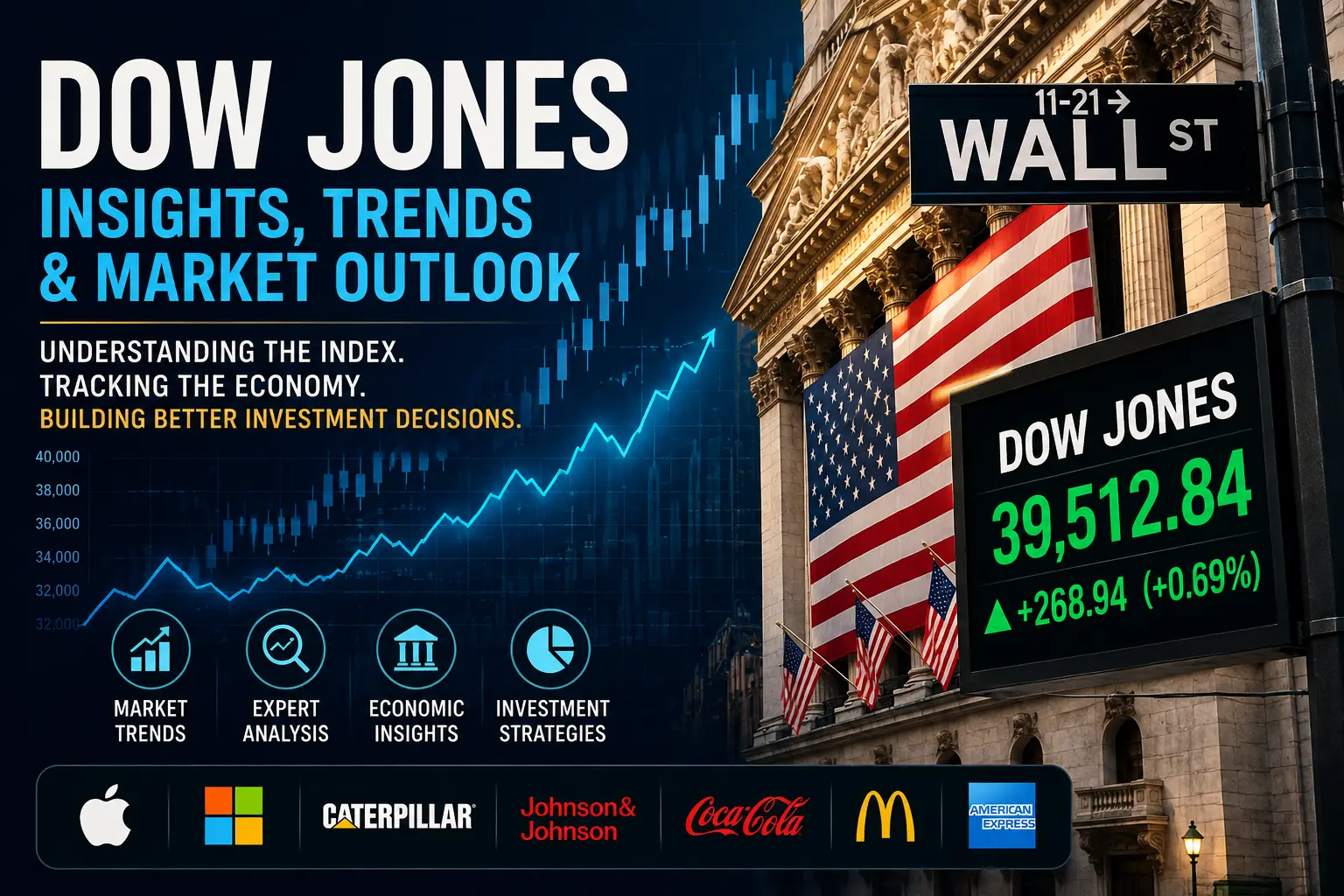
Dow Jones: Understanding the Index, How It Works, and What Investors Should Know
The Dow Jones is one of the most recognized names in the global financial markets. When financial news reports that the Dow is rising or falling, millions of investors immediately understand that the movement is connected to the U.S. stock market. The index is frequently used as a headline indicator of market sentiment, economic expectations, and the performance of major American companies.
However, the Dow Jones is more than just a number displayed on financial websites. Understanding what the index represents, how it is calculated, which companies influence it, and why it moves can help investors interpret market news more effectively.
Whether you are a new investor, an experienced trader, or simply interested in financial markets, understanding the Dow Jones provides a useful foundation for following the broader U.S. economy.
What Is the Dow Jones?
The term Dow Jones is commonly used to describe the Dow Jones Industrial Average (DJIA), one of the oldest and most widely followed stock-market indexes in the United States.
The index tracks 30 large, established U.S. companies representing a variety of industries. Despite its name, the Dow is not limited to traditional industrial businesses. Its components can include companies from technology, healthcare, financial services, consumer goods, entertainment, retail, and other major sectors.
Because the Dow focuses on a relatively small group of prominent companies, it provides a snapshot of how some of America’s largest publicly traded businesses are performing.
The index is widely followed by:
- Individual investors
- Financial analysts
- Traders
- Economists
- Institutional investors
- News organizations
- Business leaders
The Dow is also frequently used as a quick reference for overall investor sentiment.
How Is the Dow Jones Calculated?
One important feature of the Dow Jones is that it is price-weighted.
This means that companies with higher share prices have a greater influence on the index’s movement than companies with lower share prices, regardless of the total market value of each business.
This is different from many other major indexes that use market capitalization to determine the influence of individual companies.
A special divisor is used to calculate the Dow and maintain continuity when companies are added or removed, or when corporate actions such as stock splits occur.
For everyday investors, the key point is simple: a percentage move in a high-priced Dow component can have a larger direct effect on the index than a similar percentage move in a lower-priced component.
This characteristic is important when analyzing why the Dow moves on a particular trading day.
What Companies Are Included in the Dow?
The Dow consists of 30 major U.S. companies selected to represent important areas of the American economy.
The composition of the index can change over time. Companies may be added or removed as the structure of the economy changes and as index administrators evaluate which businesses best represent the market.
Dow components have historically included major businesses from areas such as:
- Technology
- Banking
- Healthcare
- Consumer products
- Retail
- Entertainment
- Telecommunications
- Industrial manufacturing
- Energy
- Financial services
The diversity of the companies gives the Dow exposure to multiple parts of the economy, although its small number of constituents means it should not be considered a complete representation of every U.S. publicly traded company.
Dow Jones vs. S&P 500
The Dow Jones and the S&P 500 are both major U.S. stock-market benchmarks, but they are constructed differently.
The Dow contains 30 companies and is price-weighted. The S&P 500 represents a much larger group of companies and is primarily weighted according to market capitalization.
This difference can produce different daily performance.
For example, the Dow may rise while the S&P 500 falls, or the opposite can happen. Investors should therefore avoid assuming that one index perfectly represents the performance of the entire U.S. stock market.
The S&P 500 generally provides broader market exposure, while the Dow is often viewed as a focused collection of major established American companies.
Dow Jones vs. Nasdaq
The Nasdaq is also different from the Dow.
Nasdaq-related indexes have substantial exposure to technology and growth-oriented companies, while the Dow contains companies from a broader selection of industries.
As a result, Nasdaq can sometimes respond more strongly to developments involving technology, artificial intelligence, semiconductors, software, and other growth sectors.
The Dow may respond differently because its components represent a different mix of businesses.
Comparing the Dow, S&P 500, and Nasdaq can therefore provide investors with a more complete picture of market conditions.
What Moves the Dow Jones?
The Dow can move because of a wide range of economic, corporate, and geopolitical factors.
Corporate Earnings
Company earnings are among the most important drivers of individual stock prices.
When major Dow companies report stronger-than-expected revenue, profits, or future guidance, investors may become more optimistic about their shares.
Disappointing earnings or weaker forecasts can create selling pressure.
Because the Dow contains only 30 companies, major developments involving one or several components can have a noticeable impact on the overall index.
Interest Rates
Interest rates are another major influence on the Dow.
When borrowing costs rise, consumers and businesses may face higher financing expenses. Higher interest rates can also affect investment decisions and stock valuations.
When rates decline, financial conditions can become more supportive for certain businesses and economic activities.
Investors therefore closely watch central-bank decisions and expectations for future monetary policy.
Inflation
Inflation can influence the Dow through several channels.
Higher input costs can affect corporate profit margins, while changes in consumer purchasing power can influence sales. Inflation also affects expectations about interest rates.
If inflation remains higher than expected, markets may anticipate tighter monetary policy. Conversely, easing inflation can increase expectations for more supportive monetary conditions.
Employment and Economic Growth
Employment data can provide important clues about the health of the U.S. economy.
Strong employment and consumer income can support spending and corporate revenues. However, an extremely strong economy can also contribute to inflationary pressure and influence interest-rate expectations.
Economic growth therefore has a complicated relationship with stock prices.
Investors typically analyze multiple economic indicators rather than relying on a single report.
The Dow Jones as an Economic Indicator
The Dow is often treated as a barometer of economic confidence.
When major companies are performing well, investors may interpret rising stock prices as evidence of improving expectations for corporate earnings and economic activity.
However, the Dow should not be considered a direct measure of the U.S. economy.
Stock prices reflect expectations about the future rather than simply current economic conditions. A rising market does not necessarily mean every household or business is experiencing stronger financial conditions.
Similarly, a declining Dow does not automatically indicate that the economy is entering a recession.
It is better to view the index as one piece of a much larger economic picture.
Dow Jones and Investor Sentiment
Investor psychology plays a significant role in financial markets.
During periods of optimism, investors may be willing to pay higher prices for stocks because they expect stronger future earnings.
During periods of fear, investors may reduce exposure to equities and move toward assets they perceive as more defensive.
This can cause the Dow to experience periods of increased volatility.
Market sentiment can be influenced by:
- Geopolitical developments
- Economic reports
- Corporate earnings
- Central-bank announcements
- Political uncertainty
- Financial-market stress
- Commodity prices
- Global economic conditions
Because investors continuously adjust their expectations, the Dow can change quickly even when there has been no major change in current corporate fundamentals.
How Investors Can Gain Exposure to the Dow
Investors have several ways to gain exposure to Dow Jones companies.
One approach is to purchase individual stocks included in the index. This gives investors direct exposure to specific businesses but also creates company-specific risk.
Another approach is to use an exchange-traded fund designed to track the Dow Jones Industrial Average.
Index-tracking investments can provide exposure to multiple Dow components through a single investment. This can simplify portfolio management, although investors should still consider fees, market risk, and the concentration of the index.
Investors should also understand that buying a Dow-tracking investment is not the same as owning the entire U.S. stock market.
Why the Dow Matters to Long-Term Investors
The Dow contains many mature companies with established businesses and significant economic influence.
For long-term investors, these companies can provide exposure to a range of industries and business models.
However, the Dow should not automatically be considered safer simply because it contains large, well-known companies.
Large corporations can still experience:
- Earnings declines
- Competitive pressure
- Regulatory challenges
- Technological disruption
- Management problems
- Economic downturns
- Market valuation changes
Diversification remains important even when investing in established companies.
Dow Jones and Global Markets
Although the Dow represents U.S. companies, its movements can have global implications.
Many Dow companies operate internationally and generate revenue from customers around the world. Changes in global economic growth, currency markets, international trade, and geopolitical conditions can therefore influence their performance.
The Dow is also closely watched by international investors because movements in major U.S. indexes can influence sentiment across global equity markets.
When U.S. markets experience significant volatility, investors in Europe, Asia, and other regions may reassess their own portfolios and risk exposure.
What Investors Should Watch
Anyone following the Dow Jones should look beyond the daily index movement.
Important areas to monitor include corporate earnings, interest-rate expectations, inflation, employment data, economic growth, and major geopolitical developments.
It is also useful to examine whether a market move is broad-based or concentrated in only a few companies.
A strong Dow performance driven by several sectors may tell a different story from a rally caused primarily by a small number of components.
Likewise, a decline in the index may be less concerning if it results from temporary weakness in one industry rather than broad deterioration across the market.
Final Thoughts on Dow Jones
The Dow Jones Industrial Average remains one of the world’s most recognizable financial benchmarks. Its long history, prominent company components, and widespread media coverage have made it an important reference point for investors and businesses.
However, understanding the Dow requires looking beyond the headline number. Its price-weighted methodology, limited number of constituents, and unique composition mean that it behaves differently from broader indexes such as the S&P 500 and technology-focused benchmarks such as the Nasdaq.
Interest rates, inflation, corporate earnings, economic growth, investor sentiment, and global developments can all influence its performance.
For investors, the Dow can provide valuable exposure to major U.S. businesses and serve as an important market indicator. At the same time, it should be considered within the context of a diversified investment strategy rather than viewed as a complete representation of the U.S. economy.
Ultimately, following the Dow Jones is not simply about knowing whether the index is higher or lower today. The real value comes from understanding why it moved, what investors are expecting, and how those expectations could affect markets in the future.