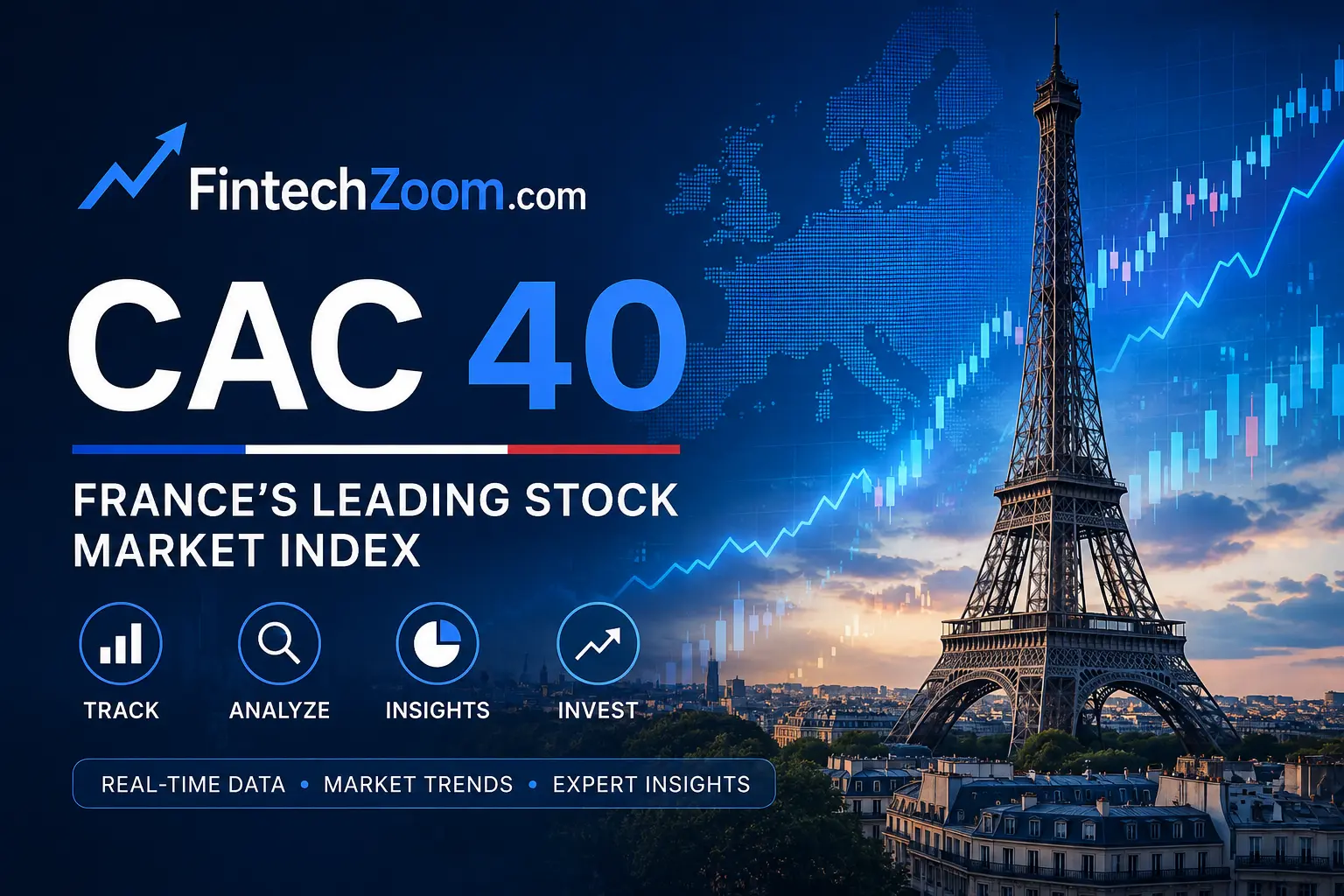
FintechZoom.com CAC 40: A Practical Guide to France’s Leading Stock Market Index
The CAC 40 is one of the most important stock market indexes in Europe. It provides a broad view of major companies listed on the French equity market and is widely followed by investors analysts traders and financial institutions.
For readers searching for FintechZoom.com CAC 40 information the index offers an important starting point for understanding how major French companies are performing. The CAC 40 can also provide useful insight into investor confidence economic conditions corporate earnings and broader European market trends.
The index contains 40 major companies selected from the French equity market. It is designed to represent large and actively traded businesses that have a significant role in the French economy and international markets. Euronext describes the CAC 40 as a free-float market-capitalization-weighted index that reflects the performance of the 40 largest and most actively traded shares listed on Euronext Paris.
What Is the CAC 40?
The CAC 40 is the benchmark stock market index for the Paris stock exchange. Its name comes from Cotation Assistée en Continu which refers to continuous quotation.
The index was introduced in 1987 and has become a major reference point for the French stock market. Investors around the world monitor the CAC 40 because many companies included in the index operate internationally.
Unlike an index that represents only one industry the CAC 40 includes companies from several areas of the economy. These businesses can include energy industrial goods financial services healthcare consumer products technology telecommunications and utilities.
This diversity allows the CAC 40 to provide a broader picture of large French listed companies.
How the CAC 40 Works
The CAC 40 uses a free-float market capitalization weighting system. This means that companies with a larger value of shares available for public trading generally have a greater influence on the index.
The weighting system is important because the movement of a large constituent can have a greater effect on the index than the movement of a smaller constituent.
Euronext also applies liquidity requirements so that companies included in the index remain suitable for investment products and market tracking.
The index is not simply a ranking of the 40 biggest French companies by total corporate value. Its methodology considers factors related to market capitalization free-float shares trading activity and investability.
Major Companies in the CAC 40
The CAC 40 includes many globally recognized businesses.
The March 2026 Euronext composition showed companies such as TotalEnergies Schneider Electric LVMH Air Liquide Sanofi Airbus Safran BNP Paribas L’Oréal AXA and Vinci among the leading constituents by index weight.
These companies represent very different areas of economic activity.
TotalEnergies provides exposure to the energy industry. Schneider Electric represents industrial technology and energy management. LVMH and L’Oréal provide exposure to global consumer markets. Airbus and Safran are connected to aerospace. BNP Paribas and AXA represent financial services.
This combination gives the CAC 40 an international character even though it is the main benchmark for the French stock market.
Why the CAC 40 Matters to Investors
The CAC 40 matters because it acts as a reference point for the performance of major French equities.
An investor can use the index to compare an individual French company with the wider market. If a stock rises while the CAC 40 falls then the company may be showing relative strength. If both move in the same direction then broader market conditions may be influencing the stock.
The index can also help investors understand changes in market sentiment.
When investors become more confident about economic growth corporate profits or financial conditions major equity indexes can benefit. When uncertainty increases the index can experience pressure.
The CAC 40 therefore provides more than a simple market number. It can act as a summary of changing expectations across a large group of major companies.
Sectors Represented by the CAC 40
One of the strengths of the CAC 40 is its sector diversity.
Energy
Energy companies can have a meaningful influence on the index. Changes in oil prices global energy demand and geopolitical developments can affect companies operating in this area.
TotalEnergies is one of the prominent constituents of the index. Its weight in the March 2026 composition was about 9.52 percent.
Industrials
Industrial companies form another important part of the CAC 40.
Businesses connected to aerospace infrastructure electrical equipment transportation and industrial technology can respond strongly to changes in global investment and economic activity.
Schneider Electric Airbus Safran and Vinci are examples of major industrial names represented in the index.
Financial Services
Banks and insurance companies are also important components.
BNP Paribas AXA and Société Générale provide exposure to the financial sector. Their performance can be influenced by interest rates credit conditions loan demand financial regulation and economic growth.
Consumer Companies
France has several internationally recognized consumer businesses.
Luxury companies such as LVMH and Hermès are followed closely by global investors because their sales depend heavily on international consumers.
Companies such as L’Oréal and Danone also provide exposure to consumer demand across different regions.
Healthcare
Healthcare companies can add another defensive element to the index.
Sanofi and EssilorLuxottica are examples of healthcare related businesses represented in the CAC 40 composition published by Euronext.
What Moves the CAC 40?
Several factors can influence the direction of the CAC 40.
Interest Rates
Interest rates can affect stock valuations and corporate financing conditions.
When borrowing costs change companies may adjust investment plans while investors may reconsider how much they are willing to pay for future earnings.
Financial companies can respond differently from technology industrial or consumer businesses. This creates different effects across the CAC 40.
Inflation
Inflation can influence corporate costs and consumer purchasing power.
Higher prices for energy transportation materials and wages can reduce profit margins when companies cannot pass those costs to customers.
At the same time moderate inflation combined with strong economic activity can support revenue growth for some businesses.
Economic Growth
Economic growth is another important driver.
Stronger economic conditions can increase demand for products and services. Weak growth can create pressure on corporate revenues and earnings expectations.
The international exposure of many CAC 40 companies means that investors also need to consider economic conditions outside France.
Energy Prices
Energy prices can have a significant effect on several sectors.
Higher energy costs can increase expenses for manufacturers transportation companies and other energy intensive businesses. Energy producers can experience a different effect depending on commodity prices and operating conditions.
Currency Movements
Currency movements also matter.
Many companies in the CAC 40 generate substantial revenue outside France. Changes in the euro against currencies such as the United States dollar can affect the value of international sales when companies report results in euros.
Currency changes can therefore influence earnings expectations even when the underlying business activity remains relatively stable.
CAC 40 and the French Economy
The CAC 40 is closely associated with the French economy but it should not be viewed as a perfect measurement of domestic economic activity.
Many companies in the index are multinational corporations. Their revenues can come from Europe North America Asia and other regions.
This means the CAC 40 can respond to global developments as well as French economic conditions.
For example a change in global luxury demand can influence a major French luxury company. A change in aircraft demand can affect aerospace companies. A change in global energy prices can influence energy producers.
The index therefore represents an important part of French listed equity markets while also reflecting international economic conditions.
How the CAC 40 Is Reviewed
Index composition can change over time because companies grow decline in market value or experience changes in liquidity.
Euronext conducts regular reviews of its CAC index family. The June 2026 quarterly review announced that there were no changes to the composition of the CAC 40 Index. The review was implemented after the market close on June 19 2026 and became effective on June 22 2026.
Regular reviews help keep the index aligned with its methodology and the changing French equity market.
Investors should therefore avoid assuming that the current list of constituents will remain unchanged forever.
CAC 40 Price Index Versus Total Return Index
There are different ways to measure the performance of the CAC 40.
The standard price index focuses on changes in the prices of its constituent shares. A total return version also considers dividends that are reinvested.
This distinction is important when comparing long-term investment performance.
An investor studying the movement of the index itself may focus on the price version. An investor evaluating the potential long-term return of an investment strategy may also want to examine total return data.
Euronext publishes different CAC 40 versions for market analysis and investment products.
CAC 40 Compared With Other European Indexes
The CAC 40 is often compared with other major European benchmarks.
Germany has the DAX. The United Kingdom has the FTSE 100. Spain has the IBEX 35. Italy has the FTSE MIB. The broader European market is represented by indexes such as the STOXX Europe 600.
Each index has a different composition and methodology.
The CAC 40 focuses on 40 major and actively traded shares connected with the French market. The STOXX Europe 600 provides much wider European exposure across countries and company sizes.
This means an investor can use several indexes together to understand regional market performance rather than relying on one benchmark.
FintechZoom.com CAC 40: What Investors Can Track
People searching for FintechZoom.com CAC 40 information may want to follow several important areas.
The first is the current index level and daily movement. This provides a quick indication of whether French large-cap equities are gaining or losing ground.
The second is constituent performance. Individual companies can have a noticeable influence on the index because the CAC 40 is weighted by free-float market capitalization.
The third is sector performance. Comparing financial industrial energy healthcare and consumer companies can help investors understand which parts of the market are driving changes.
The fourth is macroeconomic news. Interest rate decisions inflation figures economic growth data energy prices and currency movements can all affect investor expectations.
How Beginners Can Study the CAC 40
A beginner does not need to follow every company in the index.
A practical approach is to start with the overall index and then examine its largest constituents.
Next consider sector exposure. This can help explain why the index behaves differently during different economic environments.
It is also useful to compare the CAC 40 with other major European benchmarks. This can show whether a market move is mainly related to France or whether it is part of a broader European trend.
Historical performance can provide additional context. However past performance does not guarantee future results.
Why the CAC 40 Remains Important
The CAC 40 remains an important benchmark because it combines major French businesses from multiple industries into one widely followed index.
Its constituents include companies with substantial international operations. Its free-float market capitalization methodology gives larger investable companies greater influence. Its regular review process helps maintain the relevance of the index as market conditions change.
For investors researchers and financial readers the CAC 40 can serve as a useful window into French equities and broader European market sentiment.
Final Thoughts
The CAC 40 is more than a number displayed during the trading day. It is a major benchmark that brings together 40 leading and actively traded companies associated with the French equity market.
Its exposure to energy industrials financial services healthcare luxury goods consumer products technology and other industries gives investors a broad way to study major French listed businesses.
For anyone researching FintechZoom.com CAC 40 the most useful approach is to look beyond daily price movements. Understanding index composition sector exposure economic conditions interest rates currency movements corporate earnings and international demand can provide a much clearer picture of what is driving the market.
The CAC 40 can therefore serve as an important starting point for understanding French equities while also offering insight into wider European and global investment trends.
This article is provided for educational and informational purposes. It is not investment advice. Market data and index composition can change over time so readers should verify current information with official market sources before making investment decisions.