What Drives Nickel Price? 5 Factors Explained Simply
Nickel sits behind stainless steel and electric car batteries. Its price moves on a handful of forces that are easy to follow once you know them. So what drives nickel price? In short: how much Indonesia mines, what Jakarta decides on quotas and export rules, and how much stainless steel the world makes. Then there is how fast electric cars adopt nickel-free batteries, and how much metal sits in London Metal Exchange warehouses.
As of 25 November 2026, the London Metal Exchange (LME) three-month nickel price was about $15,140 a tonne, down 2.1% on the day, according to Reuters via Business Recorder. LME cash nickel closed at $15,060–$15,218 a tonne on 24 November 2026. It is roughly $1,200 a tonne below the near-$16,385 a tonne of 8 November 2026, inside a one-year range of $14,223 to $19,649 a tonne. This article explains the five factors behind those moves. For the basics of the metal itself, see our nickel guide.
1. Indonesia’s Supply and the Export Ban
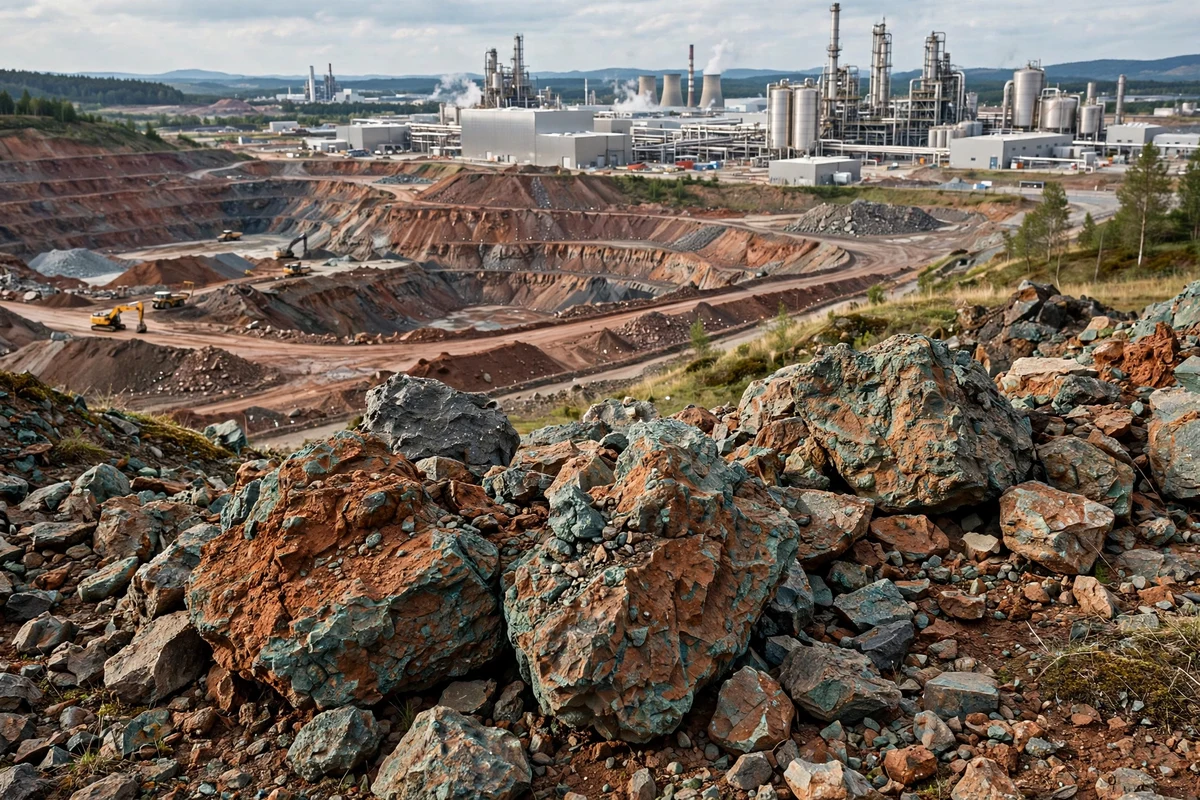
One country dominates nickel. Indonesia mined 2.6 million tonnes of the 3.9 million tonne world total in 2025. That is 66.7% of global mine production, according to the US Geological Survey’s Mineral Commodity Summaries 2026, published in February 2026. The next largest producers are far behind, the Philippines at about 7% and Russia at about 5%. Indonesia also holds roughly 42–44% of world nickel reserves.
Jakarta has used that position deliberately. Indonesia first banned exports of unprocessed nickel ore in 2014. It briefly relaxed the ban in 2017, then reimposed it in January 2020. The ban is still in force. Raw ore exports are now close to zero; instead, Indonesia exports processed ferronickel, nickel pig iron and mattes, keeping the value of processing at home. It has worked: Indonesia is now the world’s nickel refining centre as well as its biggest miner.
A World Trade Organization panel (case DS592) ruled the ban inconsistent with Article XI:1 of the General Agreement on Tariffs and Trade, which bans quantitative export restrictions. Indonesia maintains the ban anyway, and the market prices nickel with that in mind.
2. The 2026 Quota Cut
In 2026, the story moved from the export ban to something more direct: mining quotas. Through its RKAB work-plan system, Indonesia approves how much ore each mine may produce. In 2026 it cut those quotas by about 30% — from around 379 million tonnes in 2025 to roughly 250–270 million tonnes in 2026. The first batch was about 235 million tonnes. Smelters need roughly 340–350 million tonnes a year, so the cut created a shortfall.
Treat the exact quota as a range, not a settled number: the first batch is reported at about 235 million tonnes, the 2026 total at 250–270 million tonnes, and later top-ups at 290–300 million tonnes. The direction is not in doubt — Jakarta cut supply sharply to support prices after years of glut.
Jakarta also raised mining costs in 2026. Under energy ministry decree ESDM 144/2026, the correction factor on the HPM ore benchmark price rose from 17% to 30%. The nickel royalty rose from about 10% to 14–19%. That pushed up ore costs, and with them the price of processed nickel.
Then, on 14 November 2026, President Prabowo ordered at least 70% of mining proceeds to benefit the state, with exports passing through a single-window gate run by state firm PT Danantara. Ferroalloys, including nickel pig iron, fall under the state minerals agency DSI, with full enforcement from 1 January 2027, and officials have signalled the 2027 quota will be lower still.
3. Stainless Steel Demand
While supply is an Indonesian story, demand is mostly a stainless steel story. Stainless steel accounts for roughly 64–66% of all nickel use, according to the OECD in 2026 and the International Nickel Study Group’s World Nickel Factbook 2024. The Nickel Institute’s 2024 data points the same way. Batteries take about 15–16%. The rest goes to alloys, plating and other uses. So the nickel price is, first and foremost, a stainless steel price in disguise.
Stainless demand held up in 2026: global stainless melt-shop production grew 5% in the first half of the year. Melt shops make raw stainless steel, so their output tracks nickel consumption: when construction and appliances sell, mills run hard and nickel gets pulled through.
Stainless demand is steadier than battery demand: people buy fridges and build kitchens in good years and bad, while electric car sales swing with subsidies and interest rates. Stainless is the base load of the nickel market: it sets the floor under demand, and when it weakens, nickel feels it first. Nickel is not the only industrial metal whose price follows one big end use — see our platinum vs palladium investment guide for a similar story in precious metals.
4. EV Batteries and the Rise of LFP
Electric vehicles are the growth story in nickel, but a more complicated one than it looks. The International Energy Agency counts nickel use in EV batteries nearly doubling, from 222,000 tonnes in 2021 to 439,000 tonnes in 2025 — about 12% of total nickel demand in 2025. More electric cars should mean more nickel.
The catch is the chemistry. Lithium iron phosphate (LFP) batteries contain no nickel at all. LFP took more than 55% of global EV battery deployment in 2025, according to the IEA’s Global EV Outlook 2026. That is up from about 50% in 2024 and under 30% in 2022. LFP packs were more than 40% cheaper per kilowatt-hour than nickel-based NMC packs in 2025. That is why carmakers keep switching. The International Nickel Study Group reports nickel use in EV batteries actually slipped slightly in 2025, even as total nickel use grew.
Outside China, nickel-based chemistries still made up about 80% of batteries deployed in 2025, so the LFP cap is mostly a China story for now — but it is spreading as Western carmakers chase cheaper cars. EV growth is real, but no longer a one-way tailwind for nickel: every point of share LFP takes from NMC is demand that never happens.
5. LME Stocks and the Five-Year Surplus
The fifth factor is the warehouse. LME warehouse stocks stood at 275,600 metric tonnes as of 24 November 2026, down 1.8% over the previous 30 days. Falling stocks usually support prices: metal is being drawn out of storage and used.
But the bigger picture is the surplus: the International Nickel Study Group counts a global surplus in every year from 2022 to 2025, including 283,000 tonnes in 2025 alone. Five straight surplus years are the dominant bearish force in this market, and the reason the price has fallen about 42% from 2022 to around $15,000 a tonne in 2025.
That is the tension on 25 November 2026: a five-year glut and a price down roughly $1,200 a tonne since 8 November, against falling LME stocks and a deliberate supply cut. Which side wins decides where the price goes next.
What Drives Nickel Price at a Glance
Nickel is a small, policy-driven market next to the big equity indexes — for the wider picture, see our Russell 2000 vs S&P 500 guide.
| Factor | What it does | Direction in 2026 | Key figure |
|---|---|---|---|
| Indonesia supply and export ban | One country controls two-thirds of mined nickel; raw ore stays home | Supportive of prices | 66.7% of 2025 world mine output |
| 2026 quota cut | Jakarta cut mining quotas ~30%, creating an ore shortfall | Supportive of prices | Quotas cut to roughly 250–270 Mt from 379 Mt |
| Stainless steel demand | The biggest use of nickel, about two-thirds of demand | Steady | Melt-shop output up 5% in H1 2026 |
| EV batteries and LFP | Battery nickel demand grows, but LFP uses no nickel | Mixed | LFP over 55% of EV battery deployment in 2025 |
| LME stocks and surplus | Five surplus years weigh on price; stocks now drifting lower | Bearish, easing | Stocks 275,600 mt on 24 Nov 2026; 2025 surplus 283 kt |
Frequently Asked Questions
Why did the nickel price fall in November 2026?
The LME three-month price fell from about $16,385 a tonne on 8 November 2026 to about $15,140 a tonne on 25 November 2026 — roughly $1,200 a tonne, including a 2.1% fall on 25 November itself. The broader backdrop is a five-year supply glut: the International Nickel Study Group counts a surplus in every year from 2022 to 2025, and the price is down about 42% from 2022. The quota cut and falling LME stocks lean the other way, but they had not yet outweighed the glut.
Does Indonesia control the nickel price?
Not entirely, but no other country comes close. Indonesia mined 66.7% of the world’s nickel in 2025 and holds about 42–44% of reserves. Through the export ban and the 2026 quota cut, Jakarta can tighten supply like no other producer. Even so, stainless steel demand, LFP batteries and LME stocks all move the price too. Indonesia sets the weather, not the exact temperature.
Will electric cars push nickel prices up?
They help, but less than they used to. Nickel use in EV batteries nearly doubled from 222,000 tonnes in 2021 to 439,000 tonnes in 2025, according to the IEA, but that is still only about 12% of total nickel demand. Meanwhile LFP batteries, which contain no nickel, took more than 55% of global EV battery deployment in 2025, and nickel use in EV batteries slipped slightly. Outside China, nickel-based batteries still made up about 80% of deployments, so EVs remain a real source of demand — just a capped one.
What should investors watch for nickel in 2027?
Four things. First, the 2027 Indonesian mining quota, which officials have signalled will be lower still. Second, full enforcement of the Danantara single-window export gate and DSI control of ferroalloys from 1 January 2027. Third, LME warehouse stocks, at 275,600 metric tonnes on 24 November 2026 and drifting lower. And fourth, stainless output, up 5% in the first half of 2026 and still the biggest driver of nickel demand.
Sources
- Reuters via Business Recorder — LME nickel prices, 25 November 2026 (reuters.com and brecorder.com)
- London Metal Exchange — LME nickel prices and warehouse stocks (lme.com)
- US Geological Survey — Mineral Commodity Summaries 2026, nickel chapter, February 2026 (usgs.gov)
- International Nickel Study Group — World Nickel Factbook 2024 and market balance data (insg.org)
- Organisation for Economic Co-operation and Development (OECD) — nickel demand data, 2026 (oecd.org)
- International Energy Agency — Global EV Outlook 2026 (iea.org)
- Nickel Institute — nickel use data, 2024 (nickelinstitute.org)
- Ministry of Energy and Mineral Resources of Indonesia (ESDM) — Decree 144/2026 and mining policy announcements, November 2026 (esdm.go.id)
This article is educational information only and is not financial advice. Investing involves risk, including losing money. Figures are taken from the sources listed above and were correct on the dates shown; prices change daily. Consider speaking to a qualified financial adviser before investing.